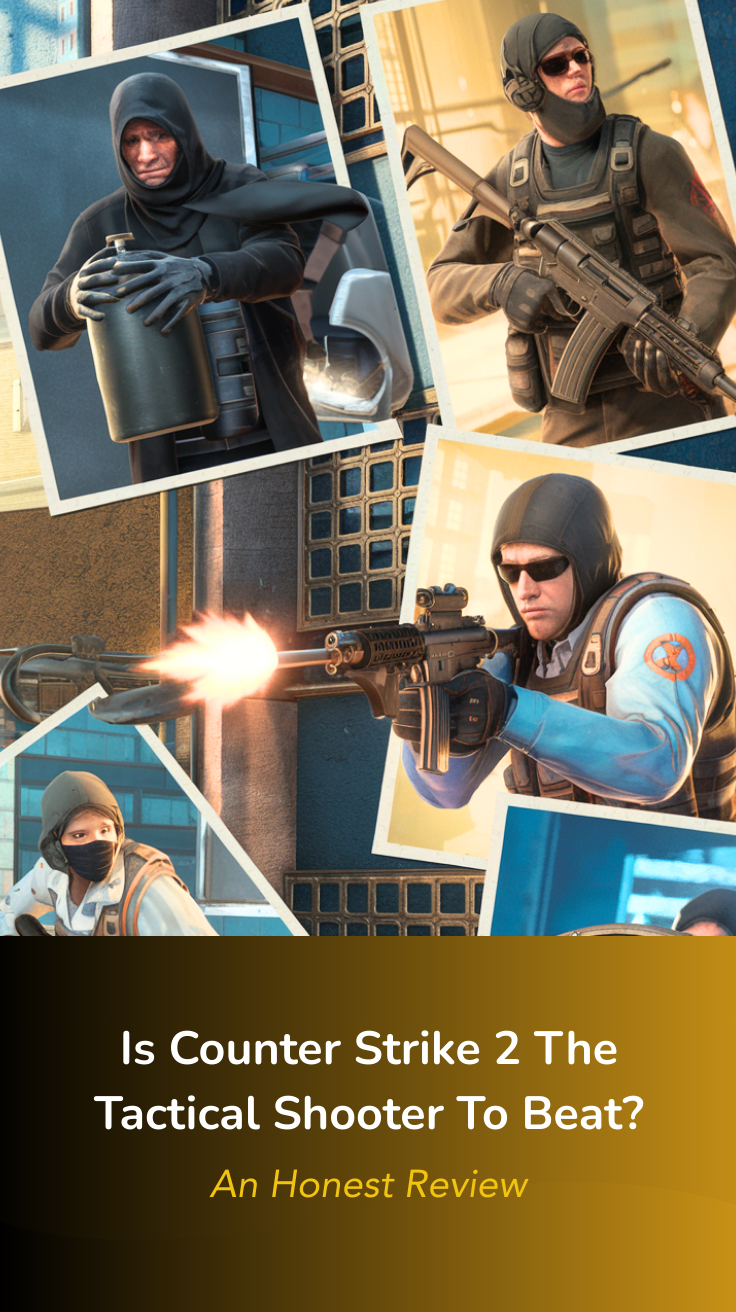
Counter-Strike 2 exists because Counter-Strike itself refuses to fade quietly into nostalgia.
Rather than launching a sequel that resets progress or splits the community, Valve chose a full replacement approach, turning CS2 into the new foundation for everything Counter-Strike represents.
This decision carries weight because Counter-Strike is not just a game but a competitive ecosystem with millions of active players, a massive skin economy, and a professional scene that spans decades.
CS2 was designed to modernize the engine, improve long-term stability, and extend the lifespan of the franchise without compromising its identity.
Instead of chasing trends like hero abilities or flashy ultimates, Valve doubled down on precision, consistency, and competitive integrity.
In many ways, CS2 is less about novelty and more about preservation through evolution.
Let’s cut to the chase and learn more about it in this post.
Read on.
How different is Counter-Strike 2 from CS at its core?
At a mechanical level, Counter-Strike 2 feels intentionally familiar.
Weapon recoil patterns remain largely unchanged, movement retains its deliberate weight, and the economic system continues to punish careless decisions.
This continuity is deliberate, as even small mechanical changes can ripple through competitive balance. However, CS2 subtly improves the feel of engagements.
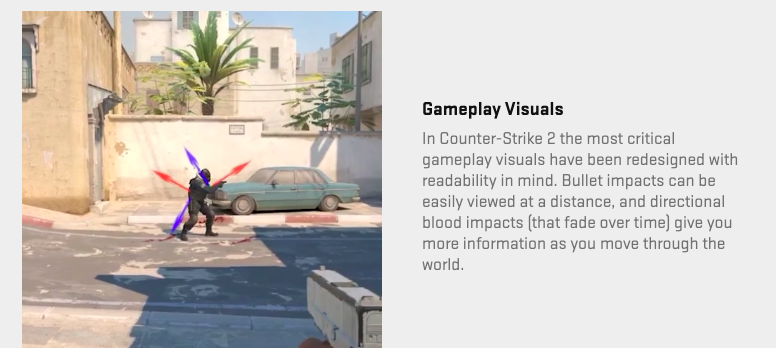
Gunfights appear cleaner, hit feedback is clearer, and visibility issues that plagued certain maps in CS are reduced.
The game feels more readable, which matters immensely in a title where information is as valuable as aim. It’s not a dramatic reinvention, but rather a refinement that prioritizes clarity over spectacle.
Why was the move to the Source 2 engine necessary?
Source 2 is the technological backbone that makes Counter-Strike 2 viable for the next decade.
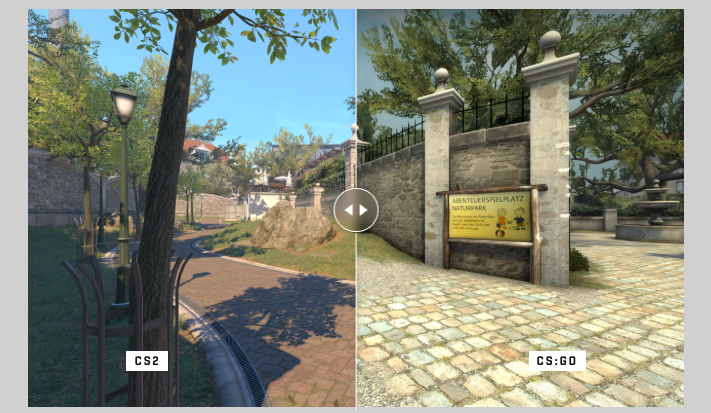
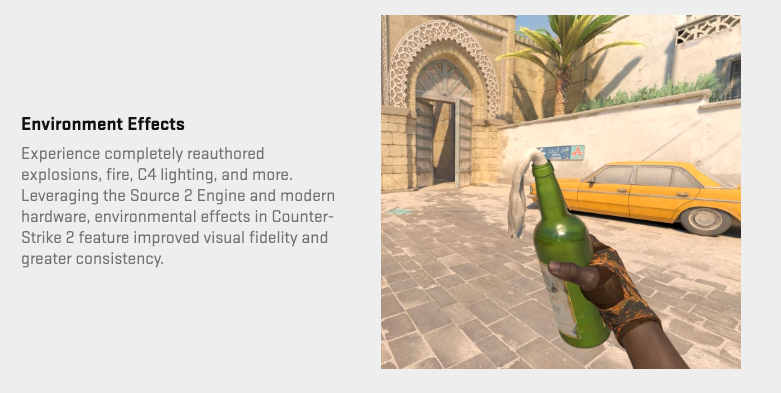
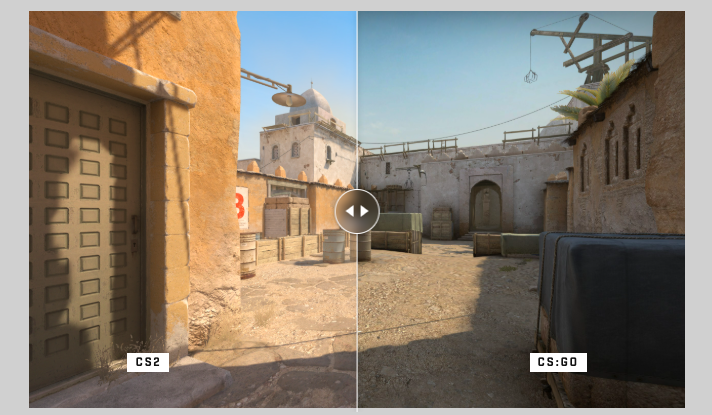
CS was running on an aging engine that had been stretched well beyond its original scope. Source 2 allows Valve to implement better lighting systems, more consistent physics interactions, and faster iteration on updates.
From a player perspective, this results in maps that look sharper, animations that feel more grounded, and fewer engine-level inconsistencies.
From a development perspective, it allows Valve to maintain the game more efficiently, push out fixes faster, and support community creators with stronger tools.
The engine shift is less visible than a new game mode, but it is arguably the most important change CS has ever received.
How does the sub-tick system change the way matches feel?
The sub-tick system fundamentally alters how the game registers player actions.
Instead of relying only on fixed server intervals, the server records the precise moment an input occurs. This matters in Counter-Strike because milliseconds determine outcomes.
In CS2, shots feel more closely aligned with player intent, reducing scenarios where a clean shot feels ignored. While sub-tick does not magically remove latency or network issues, it significantly improves consistency.
Over long play sessions, this creates a subtle but meaningful improvement in fairness. Players may not always notice it consciously, but they feel it when exchanges resolve the way they expect them to.
How have smoke grenades transformed tactical play?
Smoke grenades in Counter-Strike 2 are no longer static visual walls.
They are volumetric objects that interact with the environment. Explosions can disperse them, bullets can carve temporary sightlines, and their behavior feels more physically grounded.
This has a major tactical impact. Teams can no longer rely on smokes as guaranteed vision denial. Instead, smokes become dynamic tools that demand adaptation.
This change adds depth without overwhelming players with new mechanics. It rewards creativity and timing rather than memorization, making mid-round decisions more fluid and reactive.
What changes were made to maps and why do they matter?
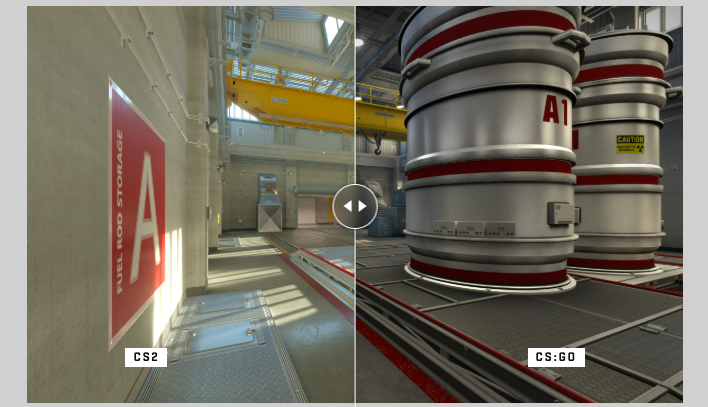
Maps in CS2 were handled with restraint and intention. Some were rebuilt from the ground up, others were visually enhanced, and a few were left nearly untouched.
Even when layouts remain the same, lighting changes alone can shift how a map plays. Dark corners are less oppressive, player models stand out more clearly, and long sightlines are easier to read.
These adjustments reduce frustration without lowering the skill ceiling. Veteran players still benefit from experience, but success relies more on decision-making than exploiting visual ambiguity.
Map knowledge remains critical, but visibility no longer feels like an obstacle.
How does Premier mode reshape competitive matchmaking?
Premier mode represents Valve’s attempt to align ranked play with professional Counter-Strike.
Instead of simply queuing into a random map, teams vote and ban maps before a match begins. This adds a strategic layer before the first round is even played.
The numerical rating system also provides clearer progression than traditional rank badges alone. While the system is not perfect, it encourages serious play and reduces randomness.
Premier feels less like casual ranked grinding and more like structured competition, which suits Counter-Strike’s identity.
How accessible is Counter-Strike 2 for casual and new players?
Accessibility remains one of Counter-Strike’s weakest areas, and CS2 does little to soften that reality.
New players are dropped into an environment where mechanical skill, map knowledge, and game sense are expected.
There are no lengthy tutorials or forgiving onboarding systems. However, casual modes and deathmatch provide safe spaces to learn fundamentals.
The game rewards patience and persistence, but it demands effort. For players willing to learn, the payoff is a deep sense of mastery that few shooters offer.
How does Counter-Strike 2 perform on modern hardware?
Performance in CS2 has improved significantly since launch, especially on newer systems.
Frame rates are stable on modern CPUs and GPUs, and the game scales well across different configurations.
That said, CS2 no longer supports older operating systems or very outdated hardware. This decision improves long-term stability but reduces accessibility.
Players with modern PCs will find CS2 smooth and responsive, while those on legacy setups may be forced to upgrade or move on.
Is Counter-Strike 2 free-to-play or does it rely on monetization pressure?
Counter-Strike 2 remains free-to-play at its core. Monetization is almost entirely cosmetic, revolving around weapon skins, cases, and cosmetic drops.
Competitive advantages cannot be purchased. Prime or Premier access unlocks certain features and matchmaking options, but skill remains the defining factor.
This model keeps the playing field fair while sustaining the game financially. Players who never spend money are not disadvantaged in matches.
What game modes and content options are available?
CS2 includes competitive, Premier, casual, deathmatch, wingman, and community-driven modes.
While some features were missing at launch, updates have steadily expanded available content. The Workshop remains a critical component, allowing players to access custom maps, training tools, and experimental modes.
This ensures that CS2 remains engaging even outside ranked play. Whether practicing aim or experimenting with community creations, there is always something to do.
How has the community responded since CS2 replaced CS?
Community response has been complex. Initial frustration stemmed from missing features, performance issues, and the abrupt replacement of CS.
Over time, consistent updates and improvements have stabilized sentiment. While not everyone is fully satisfied, the majority of players acknowledge that CS2 is moving in the right direction.
The competitive scene adapted quickly, content creators returned, and player activity stabilized. CS2 did not have a flawless start, but it has shown steady growth.
What does the esports future look like for Counter-Strike 2?
Esports remains one of CS2’s strongest pillars. Professional tournaments continue without disruption, and the game translates well to spectators.
The clarity improvements make matches easier to follow, while the unchanged core mechanics preserve competitive depth.
CS2 is built to support long-term esports growth, and its technical upgrades ensure stability for high-stakes play. The professional ecosystem remains healthy and highly visible.
Are there long-term concerns players should be aware of?
The main concerns revolve around optimization, cheating prevention, and content pacing.
Counter-Strike’s longevity depends on consistent updates and trust between developers and players. Valve’s hands-off communication style can frustrate some, but its history of long-term support offers reassurance.
As long as performance improvements continue and competitive integrity is protected, CS2’s foundation remains solid.
So, how good is Counter-Strike 2?
Counter-Strike 2 is worth your time.
It remains one of the most skill-driven and rewarding competitive shooters available.
While it is not beginner-friendly and requires modern hardware, it offers unmatched depth, fairness, and longevity.
For players who value precision, teamwork, and meaningful improvement, CS2 continues to deliver an experience few games can match.
It is not just surviving in the modern gaming space — it is still setting the standard.
Enjoyed the post?