
Ever needed to sign up for something online but didn’t want to hand over your real email address?
Maybe you’re downloading a “free” ebook that requires registration, or testing a service you’re not sure about, or just trying to avoid the inevitable spam tsunami that follows every newsletter signup.
That’s where GuerrillaMail comes in, a disposable email service that’s been around since 2006, offering temporary inboxes that self-destruct faster than a Mission Impossible message.
GuerrillaMail gives you an anonymous, temporary email address that you can use right away without any registration.
No passwords, no personal information, just instant access to a throwaway inbox.
It’s become one of the go-to solutions for people who value their privacy or simply want to keep their primary inbox clean.
But is it actually worth using? Let’s dig into what makes this service tick.
What exactly does GuerrillaMail do for you?
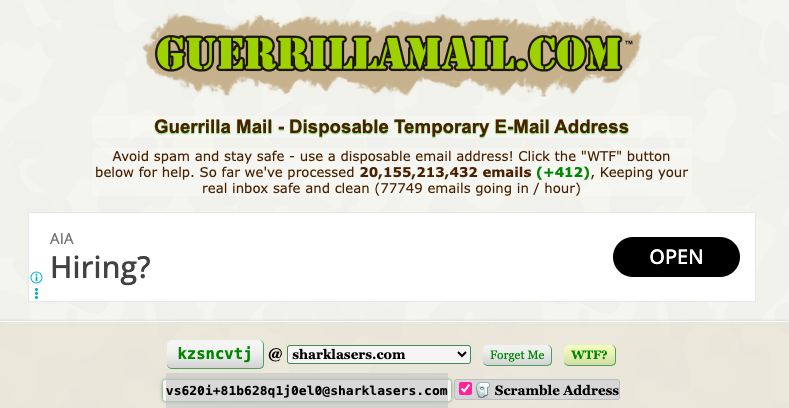
GuerrillaMail generates a random email address the moment you land on their website.
You don’t create an account, the service just hands you a temporary inbox that lives for about an hour by default, though you can extend this if needed.
You can receive emails at this address, read them, click links, and even reply to messages. Once your session expires or you close the browser, everything vanishes without a trace.
The service offers multiple domain options to choose from (like guerrillamail.com, sharklasers.com, or grr.la), which can be handy if a particular domain gets blocked by a website.
You can also customize the first part of your email address if the random string they generate doesn’t suit you.
There’s a browser extension and mobile app available too, though the core functionality lives on their website.
How much does this privacy actually cost you?
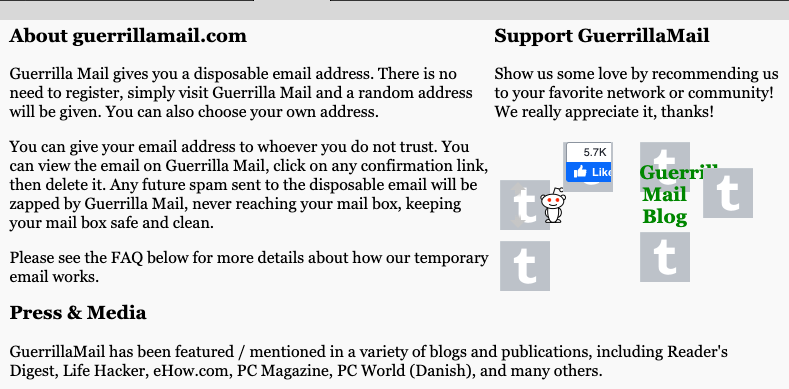
Here’s the pleasant surprise: GuerrillaMail is completely free.
There are no premium tiers, no hidden charges, and no “upgrade to see more features” nonsense.
The service runs on donations and presumably some advertising revenue, though the ads aren’t particularly intrusive. This makes it accessible to anyone who needs a quick disposable email without pulling out a credit card.
The free nature is both its strength and limitation. Because there’s no paid tier, you don’t get advanced features like longer retention periods, larger storage, or guaranteed uptime.
But for most use cases, signing up for a trial, verifying an account, or avoiding spam, the free service does everything you need.
Also Read: Best 10MinuteMail Alternatives
Can you actually trust it with your privacy?
This is where things get interesting.
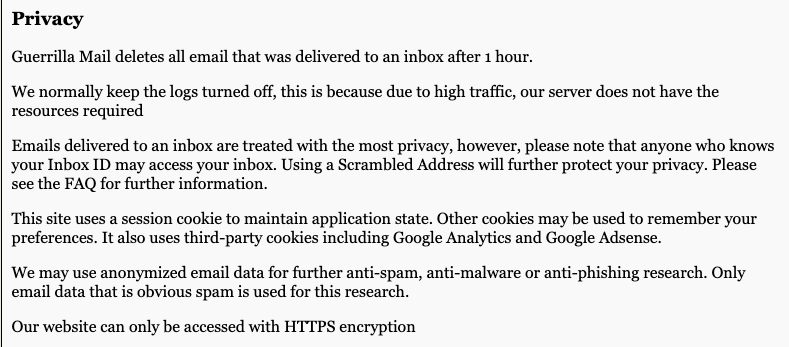
GuerrillaMail positions itself as a privacy-focused service, and in many ways it delivers. They don’t require registration, don’t collect personal information, and emails are automatically deleted after an hour.
There’s no permanent record of your temporary inbox tied to your identity. They also don’t log IP addresses in a way that would identify individual users, according to their privacy policy.
However, and this is important, the emails you receive aren’t encrypted. Anyone with access to GuerrillaMail’s servers could theoretically read your messages.
The service itself states that you shouldn’t use it for anything sensitive or confidential. It’s designed for throwaway interactions, not for receiving your bank statements or private communications.
Think of it as a privacy tool for avoiding spam, not a security vault for protecting secrets.
What happens when websites fight back against disposable emails?
Many websites have caught on to disposable email services and actively block them.
Netflix, PayPal, many banks, and countless other services maintain blacklists of known temporary email domains.
GuerrillaMail’s domains are widely recognized, which means you’ll frequently encounter registration forms that reject them outright.
This cat-and-mouse game has led GuerrillaMail to offer multiple domain options, but determined websites eventually add these to their blocklists too.
If you’re trying to create an account on a major platform or service that verifies email legitimacy, there’s a decent chance GuerrillaMail won’t work.
For smaller websites, forums, or services that don’t actively combat disposable emails, it works like a charm.
Does it actually work reliably when you need it?

In my research on user experiences, reliability seems to be a mixed bag.
When GuerrillaMail works, it works instantly, emails arrive within seconds, and the interface is responsive. The problem is that “when it works” is doing some heavy lifting in that sentence.
Users report occasional downtime, emails that never arrive, or temporary addresses that get recognized and blocked mid-signup.
The service doesn’t guarantee delivery, and there’s no customer support to contact if something goes wrong.
This is the tradeoff of a free, anonymous service. For low-stakes situations, this unpredictability is annoying but manageable.
If you absolutely need to receive an email for something time-sensitive, relying solely on GuerrillaMail might leave you frustrated.
How does the actual user experience feel?

The interface is refreshingly straightforward.
You land on the page, and your temporary email address is already waiting for you. Emails appear in a simple inbox view, you can open them with one click, and that’s pretty much it.
There’s no learning curve, no confusing settings, and no unnecessary features cluttering the experience.
That said, the design feels dated, functional but not particularly modern or polished. The mobile experience through the browser can be clunky, though the dedicated apps improve this somewhat.
You can’t organize emails into folders, star important messages, or do anything beyond the basics of receiving and reading.
But again, this is a disposable email service, not Gmail. The simplicity is actually a feature for most users who just want something quick and temporary.
Also Read: Best Mailinator Alternatives
What are the real-world scenarios where this actually makes sense?

GuerrillaMail shines in specific situations. These are all perfect use cases.
- Signing up for one-time downloads
- Accessing gated content that requires an email
- Testing a service before committing,
- Creating temporary accounts for research
- Registering for forums you’ll probably never visit again
It’s also handy for avoiding newsletter signups that you know will flood your inbox.
And where does it not make sense?
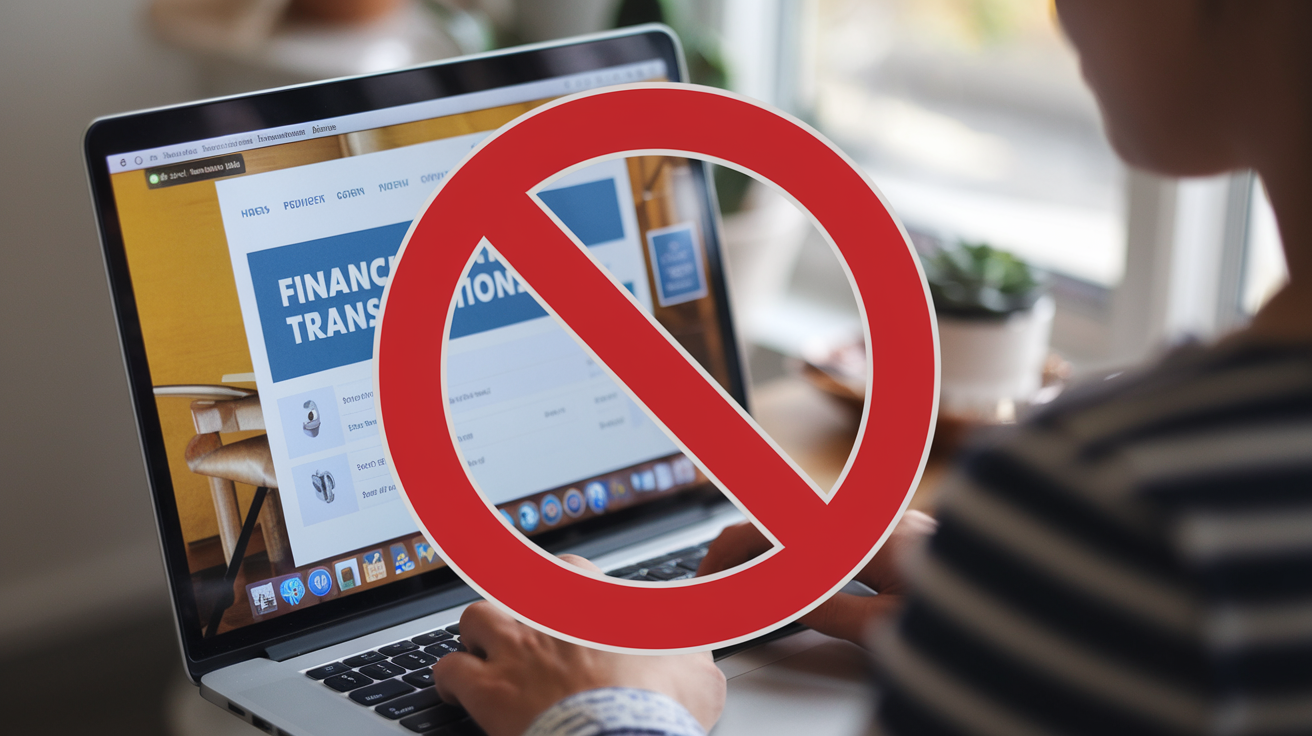
If you’ll need to reset a password later, recover an account, or receive critical notifications, a disposable email will leave you stranded.
It’s a tool for throwaway interactions, not for building anything you care about maintaining.
Don’t go for a disposable email for following uses:
- Anything requiring account security
- Receiving important documents
- Ongoing correspondence
- Financial transactions
- Creating accounts you actually plan to use long-term.
Are there actually better alternatives out there?

GuerrillaMail exists in a crowded field. Temp Mail, 10 Minute Mail, Mailinator, and dozens of others offer similar services with slight variations. ]
Some offer longer retention periods, others have better mobile apps, and a few provide additional features like attachments or custom domains.
Temp Mail, for instance, has a cleaner interface and receives regular updates. 10 Minute Mail is even more minimalist but with stricter time limits.
For users wanting more control, services like SimpleLogin or AnonAddy offer alias emails that forward to your real inbox, giving you disposable addresses without the complete anonymity (and limitations) of GuerrillaMail.
These typically require accounts and sometimes cost money, but they work with services that block traditional disposable email domains.
The best alternative really depends on whether you prioritize complete anonymity or reliable delivery.
What about the legal and ethical considerations?
Using disposable email services is legal in most jurisdictions, you’re not breaking any laws by using a temporary inbox.
However, using them to circumvent terms of service, create multiple accounts on platforms that prohibit this, or engage in fraud definitely crosses legal and ethical lines.
Many websites’ terms explicitly forbid using disposable emails, and violating these terms could result in account bans.
There’s also an ethical gray area around using disposable emails to abuse free trials, manipulate voting or commenting systems, or evade accountability for online behavior.
GuerrillaMail itself isn’t responsible for how people use the service, but users should consider whether they’re using it for legitimate privacy protection or to do something sketchy.
The tool itself is neutral; the ethics depend entirely on your intentions.
The Verdict: Is GuerrillaMail Worth Your Time?
GuerrillaMail is one of those tools that’s incredibly useful for specific situations and completely inadequate for others.
If you need a quick, anonymous email address for throwaway signups and don’t care about long-term access, it’s perfect, free, fast, and requiring zero commitment.
The interface is simple enough that anyone can use it immediately, and when it works, it does exactly what it promises.
But it’s not a solution for anything you actually care about.
The lack of encryption means it’s not secure, the widespread blocking means it’s not reliable for major services, and the temporary nature means you can’t use it for anything you’ll need access to later.
Think of it as a privacy buffer for the disposable parts of your digital life, not a replacement for a real email address.
Enjoyed the post?