If you’re trying to decide whether the Washington Times deserves a spot in your daily news routine, you’re not alone. With paywalls popping up everywhere and every outlet getting called “biased” by someone, figuring out where to get your political news feels like work.
This Washington Times review looks at what the paper does well, how it leans, how accurate it is, whether the app works, and what your other options are if you want something different. By the end, you’ll know exactly where it fits in your news mix.
What is The Washington Times?
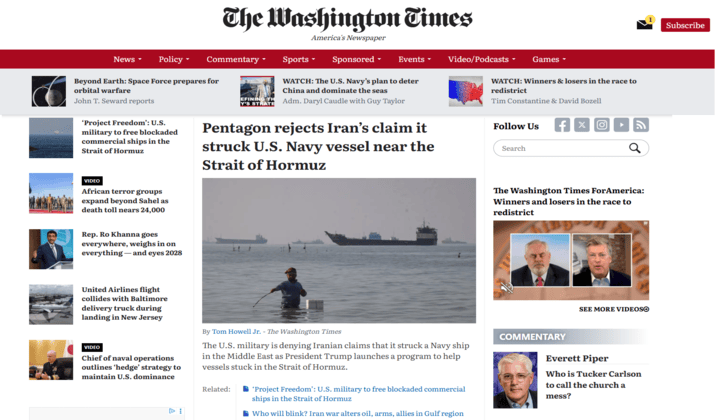
You likely know The Washington Times as a conservative D.C. paper. That reputation still holds. The Times launched in 1982 and it publishes national politics, defense, culture, faith, and opinion every day. You can read it in print, on the site, in the electronic edition, or through the mobile app.
People look up a Washington Times review for three reasons.
- You want to understand its bias and reliability.
- You want to know if the app is worth downloading.
- And you want to see how it stacks up against bigger papers.
Let’s cover each one.
Is The Washington Times Propaganda or News?
This question comes up in almost every Washington Times review, and the honest answer sits somewhere in the middle.
Ad Fontes Media rates The Washington Times as “Skews Right” for bias and “Generally Reliable / Analysis OR Other Issues” for reliability, with a score of 33.75 on its vertical scale. In other words, it falls in the analysis band, well above the propaganda or fabricated zones at the bottom of the chart.
What that means is:
- It is a legitimate news organization with a newsroom, editors, and beats.
- It publishes real reporting alongside clearly labeled opinion and analysis, rather than disguising commentary as hard news in every case.
- Some coverage and headlines strongly favor a conservative political narrative, especially on national politics and culture‑war topics.
So calling The Washington Times does not sit in the “propaganda/fabricated” category on major media‑bias charts, and it routinely publishes verifiable reporting. At the same time, treating it as fully neutral would miss the mark, because its editorial stance and story selection clearly lean right.
Also read: Fox News Review-Bias, Accuracy, App & Alternatives
Media Bias Rating
The The Washington Times has long been known as a conservative voice in American media. Most independent reviewers place it in the right of center to conservative range.
Here’s what that means for you:
- You’ll see strong coverage of conservative policies and viewpoints
- Opinion pieces often align with Republican or right leaning perspectives
- Headlines can carry a clear ideological tone
A good Washington Times review always starts with this context: it’s a right‑leaning paper with mixed reliability scores, strong conservative framing, and coverage that reflects that worldview.
This doesn’t automatically make it unreliable. It just means you should read it with awareness of its editorial stance.
Mixed Factual Reporting

When it comes to accuracy, The Washington Times typically lands in the mixed factual reporting category on major media‑watchdog sites.
In practice, here’s what you get:
- Many straight‑news articles rely on real data, named sources, and official documents.
- Some pieces use selective framing or leave out context that would soften or complicate a conservative narrative.
- Opinion columns and editorials often push those interpretations even further, clearly arguing from the right.
So it is often factual wile not always being fully balanced. You’ll see fairly standard sourcing in news stories, and openly conservative framing on the opinion pages. Watchdogs do not classify it as pure propaganda; they describe it as analysis and reporting that consistently leans right.
If you use it regularly, treat it as one voice in your mix: pair it with a couple of outlets from different points on the spectrum. That simple habit will give you a more complete picture on any political or policy topic.
NewsGuard’s Score on Credibility
NewsGuard evaluates news outlets on a 0–100 scale based on nine criteria for credibility and transparency. The Washington Times currently sits in the middle of that range, with a score around 62%, which NewsGuard classifies as “credible with significant exceptions.”
Several factors feed into that rating: the paper clearly discloses its ownership, shows some solid sourcing practices in straight‑news stories, and maintains basic transparency standards. At the same time, NewsGuard flags recurring concerns about balance, context, and how some stories are framed, which matches what many readers notice anecdotally.
The Washington Times is not treated as a fringe or “fake news” site, but it’s also not rated as fully neutral. So, it’s best read with an awareness of its conservative editorial stance.
Is The Washington Times a Reliable Conservative News Source?

If you prefer conservative viewpoints, The Washington Times can be a useful part of your media mix. It consistently covers stories and angles that resonate with right‑leaning readers, including:
- Coverage aligned with conservative policy debates and talking points
- Commentary that reflects Republican and broader right‑of‑center priorities
- News stories that spotlight issues some mainstream outlets underplay or frame differently
Where it gets more complicated is reliability.
Media Bias/Fact Check rates The Washington Times right‑center biased with mixed factual reporting and low overall credibility, citing poor sourcing in some pieces and numerous failed fact checks over the years.
Ad Fontes Media, by contrast, puts it in the “Skews Right” / “Generally Reliable – Analysis or Other Issues” band, a middle tier that reflects a mix of solid reporting and heavily framed analysis.
How “reliable” it feels depends on how you use it. Rely on it alone, and you risk a narrow, ideologically tilted view of politics and policy.
Combine it with other media across the spectrum, and it becomes far more valuable as a clearly conservative perspective you can compare against other reporting.
Check this out: 50 Best Conservative News Websites
Should I trust Washington Times for Political News?
Trusting The Washington Times is less about a yes/no verdict and more about how you use it and what you use it for.
When it’s Useful
If you lean right or want to understand conservative politics, the paper can be genuinely helpful:
- It offers coverage aligned with conservative policy debates, especially on Congress, the White House, faith, and culture.
- Its commentary tracks Republican and broader right‑of‑center priorities, so you see how the right is talking about an issue in its own words.
- Political news pages highlight issues and angles that sometimes get less emphasis in more centrist or liberal outlets, such as religious liberty fights, law‑and‑order themes, or critiques of progressive policies.
When to be More Cautious
Because it has a clear conservative stance and mixed factual ratings, you should take extra care with certain types of stories:
- Be cautious when a story reads more like a rant or argument than a straight report; that usually signals you’re in opinion territory.
- Double‑check claims that rely on a single unnamed source or offer few links to original documents or opposing views.
- Slow down when headlines feel designed to provoke anger or fear, since emotional language is a common red flag for spin rather than balanced reporting.
Treat The Washington Times as a partial lens, not the whole landscape. Pair it with outlets that have different leanings or higher fact‑reporting scores, especially on big or controversial stories.
Washington Times App Review
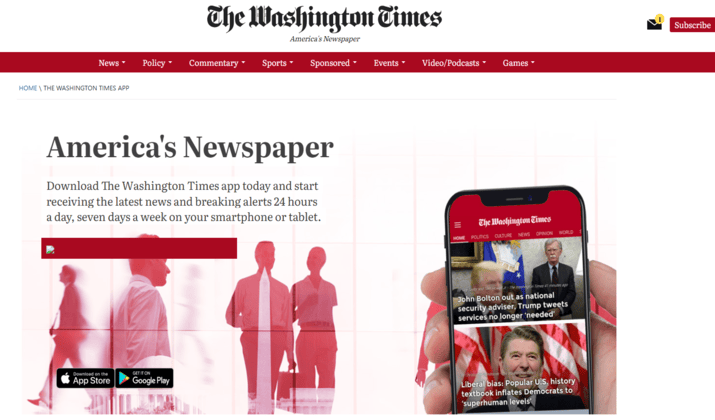
Now let’s talk about the digital experience. The Washington Times app is a platform that has improved but still has rough edges. If you already subscribe and you like a clean replica of the print paper, the app works. But, if you want video explainers, podcasts, and interactive graphics, the app feels basic.
Washington Times iOS App: Key Features
On iOS, The Washington Times app focuses on giving you a straightforward reading experience. You get:
- Full e‑edition that mirrors the print layout, with a replica-style PDF you can swipe through like the physical paper.
- Clean article layout and category‑based navigation, so you can jump between sections such as politics, opinion, and world news without much clutter.
- Offline reading for downloaded editions and saved stories, plus basic controls like adjustable text size.
It feels simple and functional rather than flashy. Readers who like long‑form pieces often say the app “stays out of the way,” even if it isn’t as polished as the very top‑tier news apps.
Washington Times Android App: Performance Overview
On Android, you get essentially the same core tools as on iOS: access to the full e‑edition, section navigation, and offline reading. The layout is similarly clean and readable, but performance can vary by device.
Common user experiences include:
- Occasional lag when loading articles or switching sections on some phones.
- Ads that interrupt the reading flow, especially in the free experience.
- Minor glitches or crashes, particularly on older devices or if the app hasn’t been updated recently.
If you run into crashes or freezing, basic troubleshooting usually helps: clear the app cache, install the latest update, and restart your device. Those steps resolve most issues users report.
Overall, the Android app works fine for casual reading of a few stories a day, but heavy readers who expect impeccable performance and zero hiccups may find it a bit rough compared with more mature news apps.
You might like this: 10 Best News Apps for Android
How Accurate is Washington Times Compared to Other Newspapers?
Let’s compare it with two major players: The Washington Post and The Wall Street Journal.
Washington Times vs Washington Post
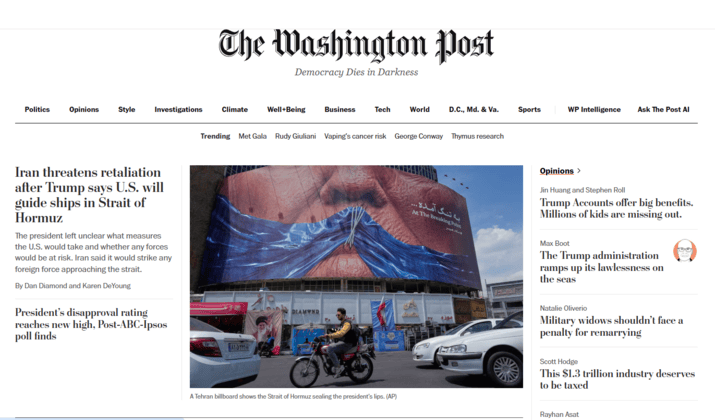
This comparison makes sense because both cover D.C. However, they serve different audiences.
The Washington Post leans often provides more detailed investigative reporting and maintains higher consistency in fact checking. Other differences include:
|
What You Compare |
The Washington Times |
The Washington Post |
|---|---|---|
|
Editorial Lean |
Right of center |
Left of center |
|
Ownership |
Linked to News World Communications operations |
Owned by Jeff Bezos |
|
Newsroom Strength |
Defense, faith, family, conservative politics |
Federal government, investigations, national policy |
|
Digital Product |
Electronic edition and a simple app |
Large multimedia team, live blogs, AI tools |
|
Typical Cost |
Mid tier for digital access |
Usually higher for full digital |
While the Post spends more on data projects and video, the Times spends more on commentary and columnists. Read both for a week and you will notice different story selection.
Washington Times vs Wall Street Journal

This is another fair match. The Wall Street Journal has a right leaning editorial page but strong factual reporting. Its news division is widely considered more neutral and it has a stronger reputation for business and global coverage. Other differences are:
|
Your Need |
Washington Times |
Wall Street Journal |
|---|---|---|
|
Main Focus |
Politics and defense from a conservative angle |
Business, markets, economics, investigations |
|
Editorial Page |
Openly right of center |
Center right, strong on finance and policy |
|
News Reliability |
Mixed, per Ad Fontes |
Consistently high for straight news |
|
App Quality |
Simple, replica edition |
Polished, with audio articles and charts |
|
Paywall |
Metered plus e edition sub |
Hard paywall, premium price |
If you live in markets and econ, start with the Journal. If you want best conservative newspapers in the US that focus on politics and culture, The Washington Times belongs on your list. Many readers use both.
Right‑Leaning News Sites Like Washington Times
Maybe you like the Times but want more voices. Here are Right‑leaning news sites like Washington Times that cover similar beats.
- Washington Examiner: Fast on Capitol Hill news and policy. It mixes reporting with conservative commentary.
- New York Post: Tabloid pace, conservative take, big on culture and politics.
- The Daily Wire: Digital first. Strong on opinion, podcasts, and video.
- National Review: Magazine history, deep on ideas and policy from a conservative view.
- The Federalist: Focus on law, culture, and religion with a combative style.
Sample a few. You will notice differences in tone and depth. That helps you build a balanced reading list.
Another interesting read: The Blaze Review-Bias, Accuracy, App & Alternatives
Washington Times Alternatives for Political News
Want less biased coverage than Washington Times?
- For facts first: AP and Reuters publish with minimal editorial language. Read them before opinion.
- For D.C. coverage rated center: The Hill covers Congress and the White House quickly. It is rated center by Ad Fontes.
- For side by side views: AllSides puts left, center, and right headlines on one page. You see framing shifts in seconds.
Each offers a slightly different tone, from mainstream to more opinion driven. These help balance out any single source.
Final Thoughts
With the Washington Times, you’re looking at a publication that:
- Delivers a strong conservative perspective
- Provides a mix of factual reporting and opinion
- Works best when paired with other news sources
The app adds convenience, though it still needs refinement. The content itself holds value, especially if you want to understand one side of the political spectrum.
Use The Washington Times for what it covers well. Defense, culture, and conservative commentary are its strengths. Add AP, Reuters, or The Hill to balance your feed. Check AllSides when you want to see how stories are framed. That mix gives you speed, context, and fewer blind spots.
If you stay aware of its bias and balance it with other outlets, the Washington Times can be a useful part of your daily reading.