Ever wonder if your email is actually private? If you’re wondering whether Proton Mail is safe to use, you’re not alone. With Big Tech scanning inboxes for ads and data leaks making headlines, more people want an inbox that actually respects their privacy.
So let’s get straight to it: is Proton Mail safe to use? While it is safe for most people, it also depends on what you’re protecting and who you’re protecting it from.
In this guide you’ll learn how Proton Mail security, privacy, and encryption works. We’ll cover what Proton can see, what it can’t, how it stacks up against Gmail and Outlook, and how to lock down your own account.
Quick Take: Is Proton Mail the Safest Email Provider?
If you want better privacy than ad-based email, Proton Mail is one of the strongest options you can use today. It’s a secure email service from Switzerland, built on end-to-end encryption, zero-access architecture, and laws that don’t force backdoors. But “safest” depends on your threat model.
Let’s break it down.
How Proton Mail Encryption Actually Works?
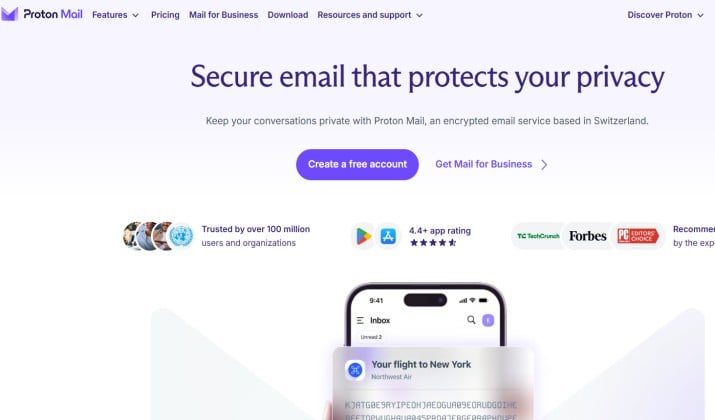
You hear “encrypted email” a lot. But what does it really mean for your inbox?
Proton Mail End-to-End Encryption for Emails Between Proton Users
When you send an email to another Proton Mail user, it’s encrypted on your device before it ever leaves. Only you and the recipient have the keys to read it. Proton’s servers can’t decrypt it.
Even if someone hacked Proton tomorrow, your messages between Proton users would still be scrambled gibberish. That’s end-to-end encryption working as it should.
Proton Mail Zero-Access Encryption for Data at Rest on Its Servers
What about emails sitting in your inbox? That’s where Proton Mail zero‑access encryption for data at rest on its servers comes in. Your messages are stored encrypted, and only your password unlocks them.
Proton calls this “zero-access” because their staff literally cannot access your emails. Lose your password and recovery phrase? Proton can’t recover your inbox either. That’s the trade-off for real privacy.
Proton Mail Encryption for Emails to Non-Proton Users via Password-Protected Messages
Sending to Gmail or Outlook? Those providers don’t support automatic E2EE with Proton. But you still have options.
You can send Proton Mail secure message links and password‑protected external emails. The recipient gets a link, enters a password you share with them, and reads the message on a secure Proton page.
It’s not as seamless as Proton-to-Proton, but it keeps the content out of Google’s and Microsoft’s scanning systems.
Zero‑Access: What Proton Can’t See
Proton Mail zero‑access encryption what it really means for your inbox is simple. Proton doesn’t hold the keys.
They can’t read your email body or scan attachments for ad keywords. Plus, they can’t hand over decrypted messages to anyone, because they don’t have the ability to decrypt them in the first place.
That’s the big difference in the Proton Mail vs Gmail for privacy end‑to‑end encryption vs ad‑based scanning debate. Gmail’s business model relies on data. Proton’s relies on privacy.
Also read: Proton Mail Free vs Premium
Metadata & Logs: What Proton Can See
Here’s where you need nuance. No email service is 100% “anonymous.” So what can Proton Mail see about you (IP address, metadata, subject lines) and what it cannot?
Can see:
- Your signup IP address by default, though you can use a VPN or Tor to create an account
- Email metadata like sender, recipient, subject lines, and timestamps. Subject lines are not end-to-end encrypted between users.
- Login times and IP addresses for security logs
Cannot see:
- Message content or attachments from Proton-to-Proton mail
- Your password or decryption keys
- Content of password-protected emails to external users
Proton Mail Metadata Limits IP Logging and Swiss Legal Jurisdiction
Proton is based in Switzerland, which has strong privacy laws. They don’t log IPs by default for normal users. But here’s the part that sparked debate: can Proton Mail be trusted after past controversies about IP logging and Swiss court orders?
In 2021, Proton complied with a Swiss court order to log the IP of a specific user involved in a criminal case. They were legally required to, and they updated their privacy policy to clarify that. It wasn’t a backdoor. It was Swiss law. Since then, Proton offers an onion site and recommends Tor for users who need to hide their IP at signup.
So yes, Swiss authorities can compel Proton to log IPs for specific accounts under investigation. They cannot compel Proton to decrypt messages, because Proton can’t do that even if it wanted to.
Read this too: Is Proton Mail the Ultimate Secure Email Solution?
User‑Side Security: You’re Half the Equation
Proton can build a vault, but you hold the key. If your password is “password123”, none of this matters. Here’s how to use Proton Mail securely enabling 2FA, strong passwords, spam protection.
- Strong, unique password: Don’t reuse it anywhere. Use Proton Pass password manager for strong, unique Proton Mail passwords. It generates and stores them so you don’t have to remember.
- Two-factor authentication: Turn on Proton Mail two‑factor authentication and AppKey for mobile apps. This stops someone who steals your password from getting in.
- Check authentication logs: Proton shows recent login activity. Glance at it occasionally for logins you don’t recognize.
- PhishGuard: Proton’s anti-phishing system flags suspicious emails. But stay alert — no filter catches everything.
- Recovery methods: Set a recovery email and save your recovery phrase offline. If you forget your password, this is your only way back.
Do that, and you’ve covered 90% of real-world attacks.
Is Proton Mail Really Anonymous or Just More Private Than Regular Email?
It’s more private, not anonymous by default. Your name, signup IP, and email metadata can exist. If you need anonymity, you’ll want to combine Proton with Tor, a VPN, and an alias that isn’t tied to your real identity.
For most people who just want to ditch ad-based scanning, Proton’s default privacy is a huge step up.
Is Proton Mail Safe Enough for Ordinary Users Who Just Want More Privacy Than Gmail?
Absolutely. If your goal is to stop your inbox from being a data source for ads, avoid mass surveillance, and keep personal emails away from corporate servers, Proton does that well.
You get encryption by default, no trackers, and a company that legally can’t sell your data. For day-to-day email, that’s a big upgrade from Gmail or Outlook.
Is Proton Mail Secure for Journalists, Activists, Lawyers, and High-Risk Users?
It’s one of the best mainstream options, but high-risk users need more than one tool. Proton Mail’s encryption and Swiss jurisdiction help a lot.
Journalists have used it to protect sources. But remember: metadata still exists, and sophisticated attackers might target your device, not Proton’s servers.
High-risk users should also use Tor, burner devices, encrypted messaging like Signal, and strict operational security. Proton is a strong layer, not the whole solution.
Can Proton Mail Be Hacked or Forced To Hand Over Your Emails to Governments?
Can it be hacked? Any system can be targeted. But Proton’s threat model is solid. Their infrastructure is hardened, and because of zero-access encryption, a server breach wouldn’t expose your message content.
Your biggest risk is someone phishing your password or compromising your device.
Can governments force them to hand over emails? Swiss courts can demand metadata and, in rare cases, IP logs for specific accounts. They cannot force Proton to decrypt messages that Proton can’t access.
That’s why Proton Mail secure email service from Switzerland matters. Swiss law doesn’t require backdoors, unlike some other countries.
Proton Mail vs Gmail Security and Privacy Comparison
|
Feature |
Proton Mail |
Gmail & Outlook |
|---|---|---|
|
Business model |
Paid subscriptions, no ads |
Free, funded by ads & data |
|
End-to-end encryption |
Yes, between Proton users |
No |
|
Zero-access storage |
Yes, emails encrypted at rest |
No, Google can access content |
|
Ad scanning |
None |
Yes, for features and ads |
|
Jurisdiction |
Switzerland |
US, subject to CLOUD Act |
|
Open source |
Proton Mail open‑source apps and audited cryptography focus |
Closed source |
|
Metadata |
Some metadata visible |
Extensive metadata collection |
So is Proton Mail safer than Gmail and Outlook? For privacy and encryption, yes. For convenience and free storage, Gmail wins. You decide what matters more.
Another interesting read: 15 Best Proton Mail Alternatives
Beyond Email: Proton Mail VPN, Drive, and Calendar as Part of a Private Ecosystem
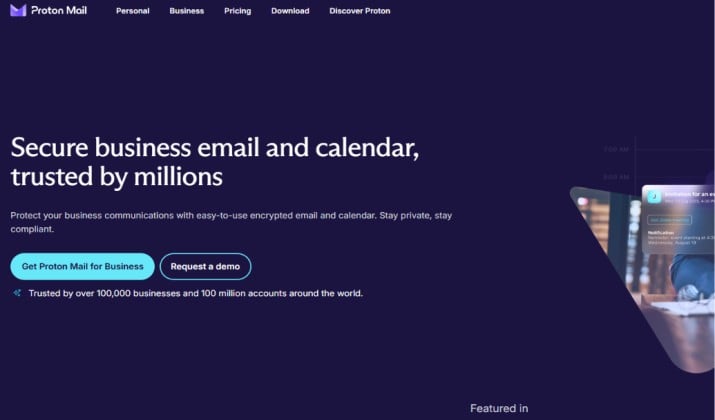
Proton isn’t just email anymore. When you sign up, you’re joining a wider suite built on the same privacy principles. Proton VPN hides your IP, Proton Drive gives you encrypted file storage, and Proton Calendar keeps your schedule out of ad networks.
Using them together reduces how much data Big Tech collects about you. It’s one account, zero-access across the board.
How To Check Proton’s Claims Yourself?
Proton Mail open‑source apps and audited cryptography focus means you don’t have to take their word for it. The web app, mobile apps, and encryption libraries are open source on GitHub.
They’ve had independent security audits by SEC Consult and others. You can read the reports yourself. That level of transparency is rare in email.
Proton Mail Pricing
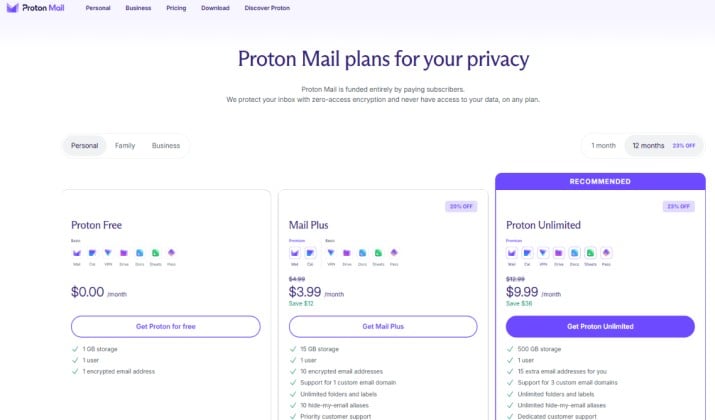
Proton Mail pricing includes a free plan, but premium tiers start at about $3.99 to $4.99/month for individuals. For the best value, users often choose the Proton Unlimited bundle at $9.99/month, which includes the mail service plus a VPN, a password manager, and cloud storage.
Individual Plans at a Glance
Proton Free: Includes 1 GB of storage, 1 email address, and basic web and app access.
Proton Mail Plus: Costs about $3.99/month (billed annually) or $4.99/month (billed monthly). It gives you 15 GB of storage, 10 email addresses, and the ability to use your own custom email domain (e.g., name@yourname.com).
Proton Unlimited: Costs about $9.99/month (billed annually). This plan upgrades your email to 500 GB of storage and 15 addresses, and it adds premium versions of all other Proton services like Proton VPN, Proton Drive, and Proton Pass.
Business and Family Plans
Business Plans: Start at roughly $6.99 to $12.99 per user per month, scaling up with more storage and administrative tools.
Family Plans: The Proton Family plan allows up to 6 members to share 3 TB of storage and all premium apps for about $29.99/month.
Because Proton is based in Switzerland, all of its services benefit from strong privacy laws, and the paid subscriptions support the free versions of the service
App links: App Store | Play Store
The Bottom Line: Is Proton Mail Safe to Use?
For most people asking “is Proton Mail safe to use,” the answer is yes. It’s a massive privacy upgrade from Gmail and Outlook. You get real end-to-end encryption, zero-access storage, Swiss legal protection, and open-source transparency.
But it’s not magic. It won’t make you invisible. Governments can still request metadata under Swiss law. If you reuse passwords or click phishing links, you can still get compromised.
If you want email that isn’t mined for ads, that can’t be read by the company hosting it, and that puts you back in control, Proton Mail delivers.