If you’re a linguaphile like me, you must have used or heard of Duolingo. It is easily the most popular language learning app that allows you to learn several languages all for free.
With over 500 million users and 10 million daily users, it isn’t hard to see why Duolingo is a popular language app. First, it uses a gamification technique that teaches you new words, sentences, and phrases. You’re then rewarded with points when you take lessons daily.
However, as much as this app covers 40 different languages and has an intuitive interface, it isn’t without flaws. I noticed that Duolingo focuses mostly on English speakers and the app seems slightly redundant.
It also seems to be better suited for kids and it isn’t necessarily the best choice if you want to advance your language skills.
The good news is that we have some good alternatives to Duolingo in the market. In fact, I have listed some of the best in the article below.
Without much ado, let’s dive in!
Also Read: Best Quizlet Alternatives
Best Duolingo Alternatives
1. Babbel

Babbel is the first language-learning app in the world and also one of the most successful. It is one of the best apps to check out if you want to learn a language from scratch or improve an already-learned language.
Babbel provides the right atmosphere to learn new languages with over 60,000 lessons to pick from. The best part is that all modules are formulated by a team of over 150 language experts to make sure you grasp concepts easily.
Each lesson is tailored to match your learning level and you can hone your pronunciation with its speech recognition feature.
There are also fun and interesting activities to do on the app. Whether you want to participate in a live class, games, watch videos, or listen to a podcast, Babbel has everything to make your learning process the best.
Over time, you’ll receive vocabulary reviews and tips so that you can track your progress and know where more work needs to be done. It also has more engaging materials than Duolingo.
To get started, you’ll need to download the app via stores.
Create an account with your email address and then select the language you want to learn. You’ll be given a placement test to determine your learning level and voila! You’re ready for an engaging learning experience.
You can download the apps here – Android/iOS
2. Busuu

Busuu is another top-notch app that gives a tough fight to Duolingo. It empowers learners by offering plentiful languages to choose from.
Each course on Busuu is developed using the internationally recognized Common European Framework of Reference (CERF) standard. It includes the four stages of the CERF standard, so you can be assured that you’re getting the best learning experience.
One of the major reasons why I like Busuu is that you get to study at your own pace. Each course is made up of bite-sized lessons so you can choose how many hours you want to spend learning. Each lesson is also sprinkled with captivating scenarios, as well as writing and listening exercises.
Unlike Duolingo, Busuu also has a smart grammar review tool that highlights words you’ve learned and those you’re still struggling with. The goal is to make sure you become skilled in the language you’re learning.
You can also share your exercises with Busuu’s community of native speakers who in turn, provide feedback that help you improve.
You simply need to select the language you want to learn and set up an account with your email address once you’ve downloaded the app.
Download the apps here – Android/iOS
3. Memrise

Memrise is another great alternative to Duolingo. With over 60 million registered users, it offers courses in 23 languages.
Like Duolingo, the app teaches language courses through a gamified method. However, Memrise takes things up a notch by mixing technology and science to bring your brain to life.
Each lesson is presented in a simplified way so you don’t have to struggle to grasp new words, phrases, or sentences. Each learning session is accentuated with fun videos and audio clips to ensure you never get bored.
The lessons are administered by a team of in-house language experts passionate about teaching their native language which means you are learning from the best.
You can learn multiple languages at the same time while tracking your progress on a leadership board.
Another reason why I like Memrise is that it has a catchy and upbeat user interface. At first glance, you can tell it is going to be a fun experience.
The sign-up process is a breeze as you only need to click on sign up and select the language you speak and the language you want to learn.
After doing that, select your learning level, then enter a username and an email address, and create your password.
Download the apps here – Android/iOS
4. Rosetta Stone

Rosetta Stone is another popular language-learning app to seek out if you’re looking for something outside Duolingo. It focuses on speaking-based lessons that ensure effective comprehension.
Rosetta Stone uses a Dynamic Immersion and Contextual learning method that combines interactive lessons with its TruAccents Technology to help you pronounce confidently.
You can hone your pronunciation and practice speaking the language with native speakers talking via the Stories feature. This feature isn’t available on Duolingo which gives Rosetta Stone an edge.
To get the translation of a sentence or phrase, you simply have to touch and hold your screen.
You can take any of the 10-minute lessons anytime you want, whether you’re online or offline, which makes it great for those on a tight schedule.
Another interesting feature I like about Rosetta Stone is that you can always take a break from staring at your screen by listening to the app’s AudioCompanion lessons.
Signing up and getting started with lessons is simple too. Check out the apps here – Android/iOS
5. Mango Languages
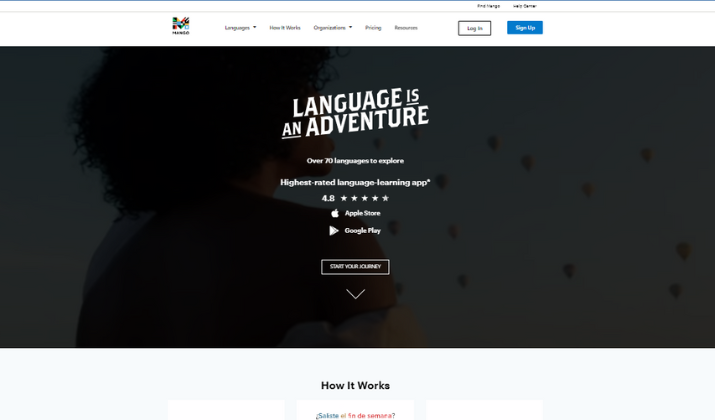
With over 70 languages available to learn, there’s no reason why you shouldn’t try Mango Languages. It is an impressive language-learning app that takes an academic approach to teaching.
Mango Languages uses the six critical language learning skills to make sure users fully grasp and understand foreign concepts.
The app uses the vocabulary, grammar, pronunciation, culture, comprehension, and retention methodology to make sure learning is effective.
Its Native Speaker Audio feature helps you speak like a native. You can also engage in real-life conversations to help improve your pronunciation.
The app not only focuses on teaching foreign languages but also provides cultural context to give you insights into these languages.
Its intelligent algorithms provide daily personalized review cards so that you don’t forget what you’ve learned.
Mango Languages is available for personal, classroom, business, and even government use.
Download the apps here – Android/iOS
6. Rocket Languages

The Rocket Languages app is perfect for both beginners, intermediate, and advanced learners.
Rocket Language not only provides 14 different languages to learn but provides cultural content to help you understand the language like a native speaker.
Each course has a state-of-the-art voice recognition system that allows you to check your pronunciation as you learn.
You also have access to the Native Speaker Audio feature that lets you download audio tracks that contain thousands of words and phrases to make learning simpler.
Rocket Languages uses an intelligent algorithm to curate fun activities alongside every lesson which identifies words and phrases you have difficulties with and lets you practice until they are etched in your memory.
The app also has thousands of audio tracks that make it a hands-free learning platform.
You can learn without having to look at a screen. It is perfect for those with visual impairments.
You can access the app by downloading it via Google Play or App Store.
7. LingoDeer

If you’re looking for a language-learning tool that offers extensive information on the language you’re interested in, LingoDeer is a perfect choice. With LingoDeer, you’ll get a detailed explanation of the language you’re about to learn, starting with the basics.
It uses a grammar-based curriculum curated by language experts, so you can get a deep understanding of your chosen language without feeling lost or confused.
You can start your first lesson on LingoDeer with audio from native speakers. That way, you already train your ears and speech to sound exactly like what you have been hearing from the very beginning.
LingoDeer makes the learning process easier by having users read out interesting stories with cultural context while learning new phrases and words.
One can also boost his language skills by playing interactive games on the app. Its intelligent algorithm also makes it easy to target weak areas and practice more.
LingoDeer also uses flashcards to review key grammar limits and ensure you don’t forget what you’ve learned.
The app is available on App Store and Google Play and setting up an account requires just a few steps. Just choose the language you want to learn, level, and enter a valid email address. You are good to get started now.
8. Drops

If you’re trying to learn a new language as a beginner, you should check out Drops.
Like Duolingo, the app uses a gamification system to help you learn new words and phrases while keeping you engaged at all times.
Drops combines fun word games and mnemonic associations in a way that makes sure anything you learn, sticks.
Offering over 45 languages and a series of bite-sized lessons, you can squeeze in time for a lesson regardless of your schedule.
There are over 20,000 illustrations that you can match with words to help improve your learning process, especially if you’re a visual learner. The app interface is simple, colorful and intuitive.
Download the app here – Android/iOS
9. Lingvist
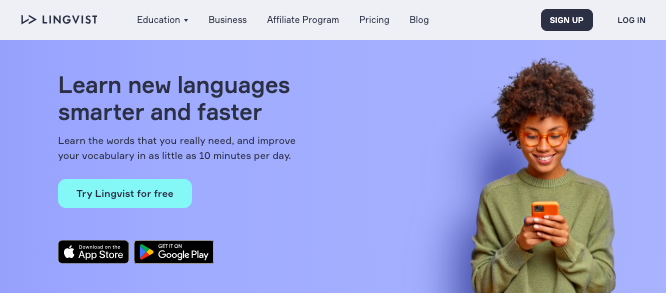
Lingvist is a smart, streamlined language learning app that shines as a powerful vocabulary builder and personalized study tool, especially if your goal is to learn the words you’ll actually use in real conversations.
Its AI-driven system uses spaced repetition to show you high-frequency words first and adapt to your strengths and weaknesses, which helps you retain vocabulary more efficiently than a generic drill system.
Lessons are clean and focused without distracting ads or animations, and you can even create custom decks based on your own interests or professional needs.
Lingvist’s interface is intuitive on both desktop and mobile, and progress tracking shows how much you’ve learned and what you should practice next.
Because it emphasizes real-life vocabulary and adjusts intelligently to your pace, many learners find that it accelerates their language ability in a way that feels purposeful and efficient.
For learners who want serious vocabulary progress rather than game-like streaks, Lingvist is a refreshing alternative to Duolingo.
Download the app here – Android/iOS
10. Mondly

11. Pimsleur
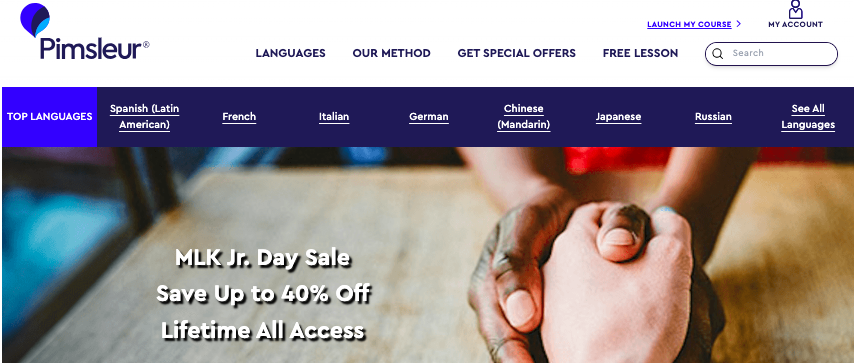
Pimsleur feels like a conversation coach in your pocket for anyone who dreams of speaking with confidence rather than just tapping words on a screen.
At its heart are 30-minute audio lessons built around natural dialogues and active repetition, designed to get your tongue moving and your ear tuned to real speech from day one.
The method cleverly uses graduated recall and spaced repetition, meaning lessons bring words back at the right moments so they stick in long-term memory.
You can learn hands-free during commutes, workouts, or chores, the perfect setup for busy lives.
Its focus on pronunciation and listening comprehension helps you sound more natural and understand native speakers more quickly than many text-heavy apps.
Many learners find it boosts conversational ability faster than Duolingo’s gamified drills, making Pimsleur a fantastic alternative for spoken fluency and real-world language use.
Download the app here – Android/iOS
12. Tandem

Tandem takes language learning to a whole new level by letting you master a language by chatting with real people. Unlike Duolingo which focuses on formal teaching, Tandem is a language exchange platform.
It uses a form of chat system that lets millions of users teach others their languages. The tandem app has both language and interactive tools that let you practice your target language with a partner.
I like Tandem because it is one of the most engaging platforms and is best suited for those who find it easier to learn in groups. You can take lessons together and practice pronunciation with a partner that also doubles as a coach to guide you.
Tandem not only lets you chat with your partner but has video, in-app correction, and translator features.
You can get started by downloading the app from either Google Play or App Store. Sign up for free with a valid email address and find the perfect language exchange partner to get started.
13. HiNative

HiNative is a unique language-learning platform that works as a question-and-answer community. That is, you can ask questions regarding a specific language and get answers from native speakers from all over the world.
HiNative also allows you to become a tutor to someone who needs to learn your language. It’s a perfect platform for those who want real-time answers to their language-related questions.
People studying for language proficiency tests as well as those interested in foreign languages and cultures, can benefit from the app bigtime.
HiNative also features a question template to help you with right questions to ask without having to think too much.
You also get to use voice recognition to post questions and get audio answers to help boost your speaking skills.
The HiNative app is free to download from Google Play as well as App Store.
14. Ling App

If you’re a fan of gamified language learning apps, then you’ll like Ling. It teaches users new languages via fun and engaging mini-games.
You get to choose from over 60 languages, depending on your level, and also listen to audio tracks from native speakers. Each lesson is bite-sized, so you only need 10 minutes to learn a language skill daily.
Although it is easy to think of it as similar to Duolingo, Ling takes things further by including puzzles, word-pictures, and matching quizzes as well as learning sentence composition.
One of the standout features of the app is its chatbot. It makes the lessons highly interactive and engaging keeping that fun element intact.
Ling is free to use and available for download on App Store and Google Play.
15. Xeropan
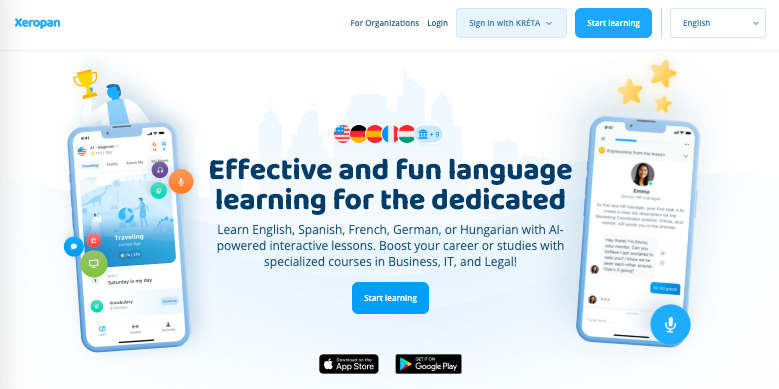
Xeropan offers a splash of adventure and gives Duolingo a run for its sparkly feathers as a solid language learning tool.
It’s crafted with structured, CEFR-aligned lessons that take you step by step from beginner to advanced skills while you collect stars and unlock new chapters, like carving your progress through a linguistic story instead of mindless tapping.
The app combines vocabulary building, grammar explanations, pronunciation practice, and real-life dialogues into bite-sized, interactive lessons that feel purposeful and playful rather than purely gamified.
Xeropan also uses AI chatbots for conversing, so you can actually talk in real contexts, and video clips help you learn expressions used by native speakers in everyday life.
Learners enjoy its thematic approach, nice balance of fun and depth, and videos that tie words to scenarios you’d actually use. This makes it a solid alternative to Duolingo if you want more real-world language immersion.
Download the app from App Store and Google Play.
Final Words